SLOW LIGHT, QUICK COLOUR
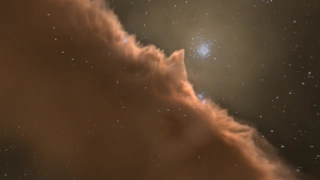
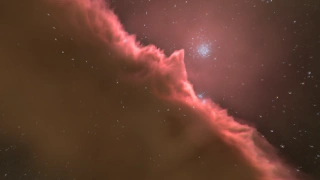
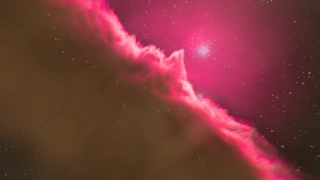
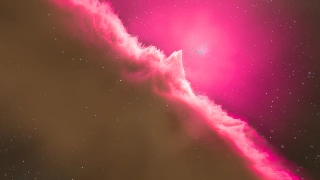
Leave a station at Crossroads, open the throttle, and the glowing rim of the nebula ahead turns pink long before the ship feels fast. It looks as if somebody turned up a filter. Nobody did. Light in U2 is slow: here it travels at 3,000 m/s, so an everyday 100 m/s is already a thirtieth of light speed. In our own universe that would be about 10,000 km per second.
Fly towards light and you meet every wave a little early, so its wavelength looks shorter. For light from straight ahead, at speeds like these:
wavelength you see ≈ wavelength at the source × (1 − v/c)
where c is the local speed of light. That is 1% shorter at 30 m/s and 3% shorter at 100 m/s. Light from behind is stretched by the same amount.
WHY THE GAS TURNS PINK
A few per cent sounds too small to see, and for most light it is. But the glowing gas of a nebula does not shine in a smooth rainbow. It shines in a handful of narrow spectral lines, and the brightest are hydrogen's red at 656 nm and oxygen's green-blue at 501 nm.
Hydrogen's line sits on the steep edge where the eye stops seeing red. Shift it 1% towards the middle of the spectrum and the eye reads it as almost one and a half times brighter; shift it 3% and it looks about three times brighter. Oxygen's line slides towards blue at the same time. Strong red plus blue reads as pink.
WHAT HARDLY CHANGES
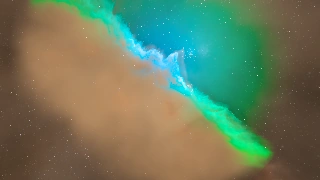
Dust, stars and stations shine with a smooth, continuous spectrum. Slide a smooth curve a few per cent and it is still much the same curve, so this light mostly grows brighter ahead and fainter behind while keeping its colour. That is why the great wall of dust at Crossroads keeps its amber-brown colour while its glowing rim, which is gas, turns pink.
FASTER, AND LOOKING BACK
At 900 m/s, three tenths of light speed, hydrogen's red line straight ahead has been pushed all the way to green-blue, around 480 nm, and the rim and the haze above it turn turquoise-green over a wall of pale sand. Oxygen's line has left the visible range altogether, into the ultraviolet.
Look back at cruising speed and the effect runs the other way, only quieter: the sky and its glowing gas dim a little and keep their colours. Go much faster and the view behind darkens almost to black.
WHAT WE TUNE FOR YOUR SCREEN
Two things are adjusted for your monitor, and neither makes the effect stronger. Brightness is compressed so that a blazing nebula and a dark sky fit on the same screen, and each sector's colour saturation is lightly tuned. The shift itself, meaning which wavelengths move where and how bright they look to you, follows the standard eye-sensitivity tables colour scientists have used since 1931.
FROM THE 0.29 EDITION
The Doppler effect is disabled in U2 0.29 while it is being reworked. The frames and descriptions above document the 0.27.13 sky; they are not a preview of the current flight view. Play prototype ↗.