A FLIGHT THROUGH CROSSROADS
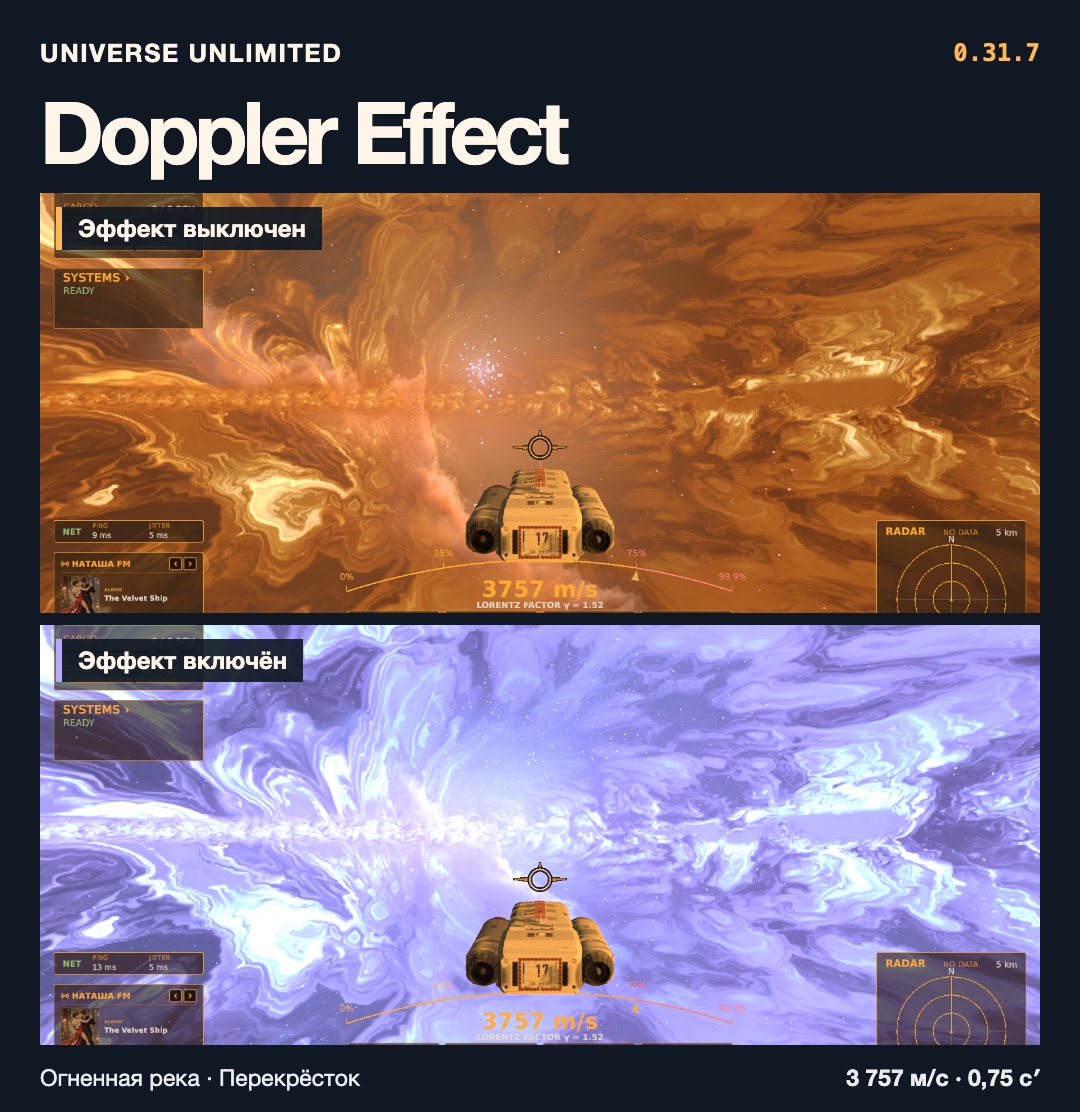
Point your ship down the Fire River at Crossroads and build up speed. The orange gas ahead takes on a violet-blue glow. Hold your speed and swing the camera aft. The sky behind you looks redder and fainter. Both views come from the same flight. As you fly towards the glowing gas, its light reaches you in quicker waves and shifts towards blue. Look back and the waves arrive farther apart. That change in the light you receive as you move is the Doppler effect.
Light travels at 5,000 m/s in Crossroads. At 100 m/s you are already moving at 2% of the local speed of light, written c′. In the flight pictured here, a Sputnik reached 3,757 m/s, about 0.75 c′. That is fast enough to change both the colour of the sky and where you see familiar landmarks.
WHAT HAPPENS TO A WAVELENGTH?
Light arrives as a wave. Fly directly towards its source and the crests reach you more often. The light shifts to a higher frequency and a shorter wavelength, a blueshift. Fly directly away and the crests arrive farther apart. This redshift takes the light to longer wavelengths.
Glowing hydrogen gives us a useful yardstick. One of its red emission lines has a wavelength of about 656 nm at rest. A pilot flying straight towards the source at 100 m/s in Crossroads would measure about 643 nm, still red. At three quarters of the local speed of light, that same line would reach the pilot at about 248 nm, in the ultraviolet.
WHY THE PLANET MOVES
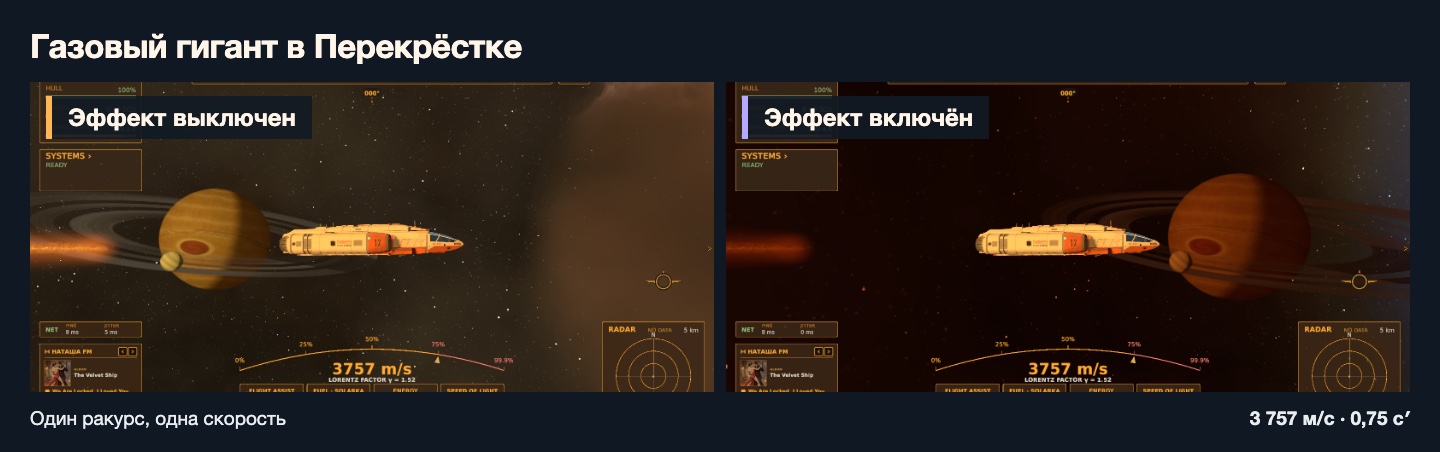
Pick a star off to one side and accelerate without turning the camera. The star appears to slide towards your direction of travel. Across the whole sky, stars crowd together ahead and spread apart behind. This change of apparent direction is called aberration.
A planet gives you a larger landmark to follow. In the paired views below, the gas giant moves from the left of the ship to the right. Its disc looks larger, darker and redder in the second view. You can still pick out its rings and cloud bands. The ship gives you a fixed reference in both frames.
FIND YOUR DIRECTION OF TRAVEL
The view follows your direction of travel. Turn the camera while coasting and you can look into the blue ahead, across the moving star pattern to one side, and back into the red behind. If you are drifting sideways, the stars gather in the direction you are sliding. Slow to a stop and they return to their usual places and colours.
HOW THE GAME CHOOSES A COLOUR
Each direction in the sky has its own Doppler factor. U2 uses that factor to shift the colours already present in the scene and to brighten or dim them. The game's colour profile sets the strength of the response. A violet patch in the Fire River shows what the pilot sees on screen. Identifying individual emission lines in real gas would take a spectrum.
TRY IT AT THE GATE
The full effect is on by default in U2 0.31.7. Try the view through the open gate from Crossroads to Severny. You can see the Fire River around the ring and Severny’s blue sky through the opening. Each side shows its own sector at your flight speed. Fly in the browser ↗.